 THE TECH SHOWCASE
By Chris Keon, an active sworn law enforcement officer and UAS program leader who has trained roughly 2,000 students in unmanned systems and national security technology across military, public safety, and commercial sectors, and has advised agencies on counter-UAS detection policy.
If you work in public safety, security, or critical infrastructure, the ground just shifted under your feet, and most agencies haven’t noticed yet.
On December 18, 2025, the SAFER SKIES Act was signed into law as part of the FY2026 NDAA. For the first time, state, local, tribal, and territorial (SLTT) law enforcement and correctional agencies can be authorized to conduct counter-UAS operations, including detection, tracking, and actual mitigation, under federal law. On July 1, 2026, the DOJ/DHS interim final rule implementing it (new Part 124) took effect. That was less than three weeks ago.
For twenty-plus years, drone mitigation was a federal-only game. If your agency jammed, seized, or downed a drone, you were potentially violating the Wiretap Act and 18 U.S.C. § 32, the aircraft sabotage statute. That wall just came down, with conditions. And the conditions are where agencies are going to get hurt.
Over the years I’ve been to multiple jails and prisons dealing with the same complaint: drones flying over the yard and dropping contraband. Drugs, cell phones, weapons, contraband in general. Every one of them said some version of the same thing: this is a huge problem, and we can’t do anything about it. And for years, they were right. The most they could legally do was detect, and most agencies didn’t even know detection was an option. They wanted a way to mitigate the problem, and the law said no. That’s exactly the wall Part 124 just took down, and it’s no accident that correctional agencies are named in the statute.
What actually changed
Plain language, no legalese:
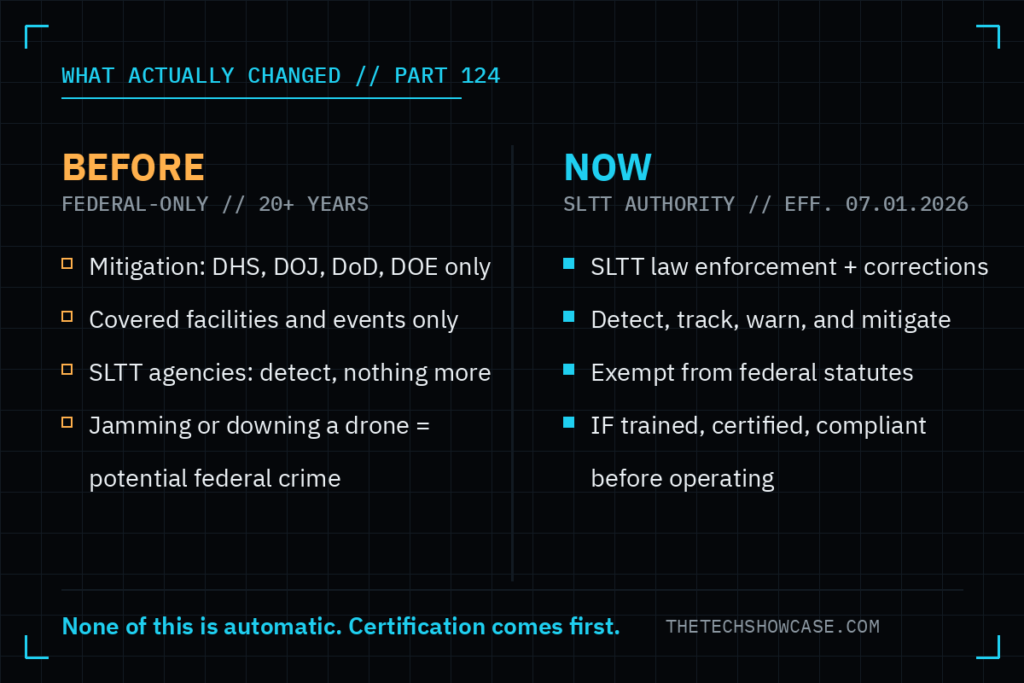
Before: Only DHS, DOJ, DoD, and DOE had mitigation authority, and only at covered facilities and events. Your police department could detect a drone. It could not touch one.
Now: The SAFER SKIES Act authorizes SLTT law enforcement and correctional agencies to detect, monitor, identify, track, warn, and, under defined conditions, mitigate UAS threats. Certified agencies acting under this authority are exempt from the federal statutes that used to make mitigation a crime.
The catch: None of this is automatic. Training, certification, and compliance requirements must be satisfied before an agency conducts counter-UAS operations. The interim final rule lays out that framework, and it has teeth: the NDAA also created enhanced penalties for unauthorized counter-UAS activity. Same technology, legal or felony, depending entirely on your paperwork and certification status.
What agencies get wrong (and will get wrong this year)
I’ve spent years training public safety and military personnel on unmanned systems, and I’ve watched agencies adopt new technology from the inside as a sworn officer. Here’s my prediction for the failure modes we’ll see as agencies race to stand up programs over the next year:
1. Buying hardware before building the program. A counter-UAS system without certified operators, documented procedures, and a legal review is an expensive liability sitting in a storage room, or worse, one that gets used before the agency is authorized. The vendor will happily sell you the equipment either way.
2. Treating certification as a one-time event. The rule establishes training and compliance requirements as ongoing conditions of authority, not a plaque for the wall. If your training records can’t survive an audit, your authorization may not survive the incident review.
3. No coordination plan. Counter-UAS operations happen in the National Airspace System. FAA coordination isn’t a courtesy. It’s baked into the framework. An agency that mitigates a drone without deconfliction procedures isn’t bold, it’s one manned-aviation incident away from ending the program for everyone.
4. Ignoring the evidence problem. As a sworn officer, this is the one I care about most. A mitigated drone is evidence. Chain of custody, forensic handling of the aircraft and its data, documentation of the decision to act under the totality of circumstances. If your counter-UAS SOP doesn’t read partly like an evidence procedure, it’s incomplete.
Any counter-UAS mitigation operation is absolutely an evidence-gathering procedure, because the moment that aircraft comes down, you’re holding a piece of hardware that contains information. Your SOP needs to be written for that. Start with the airframe itself: serial number, manufacturer, type. Even if it’s 3D-printed, it has identifying marks, from the motors and servos on down. All of it gets documented like any other piece of evidence: photos, description, GPS location of where you collected it. Then there’s the brain of the drone, where the real plethora of information sits: takeoff and landing points, stored pictures, metadata. But to access any of that, you need a warrant, just like you would for a cell phone or a laptop. Your SOP has to cover that exploitation process too, because that’s how you find who was operating it, where they flew from, and what their patterns were.
Meanwhile, on the flight operations side: Part 108 is stuck
The other regulatory story of 2026 is the one that hasn’t happened. The FAA’s Part 108 rule, the framework meant to replace case-by-case BVLOS waivers with standardized beyond-visual-line-of-sight operations, was ordered finalized by February 1, 2026 under the June 2025 executive order. That deadline came and went.
The sticking point is right-of-way: the proposed rule would give drones presumptive right-of-way over manned aircraft in defined low-altitude scenarios, and roughly half of the 3,100+ public comments hit that single issue. The FAA reopened comments twice, most recently closing February 11, 2026. As of this writing, no final rule.
What that means practically: if you’re building a drone program, Part 107 and the waiver process are still your reality for the near term. Plan for it. Don’t build your 2026 operational concept around a rule that doesn’t exist yet.
The practitioner’s checklist
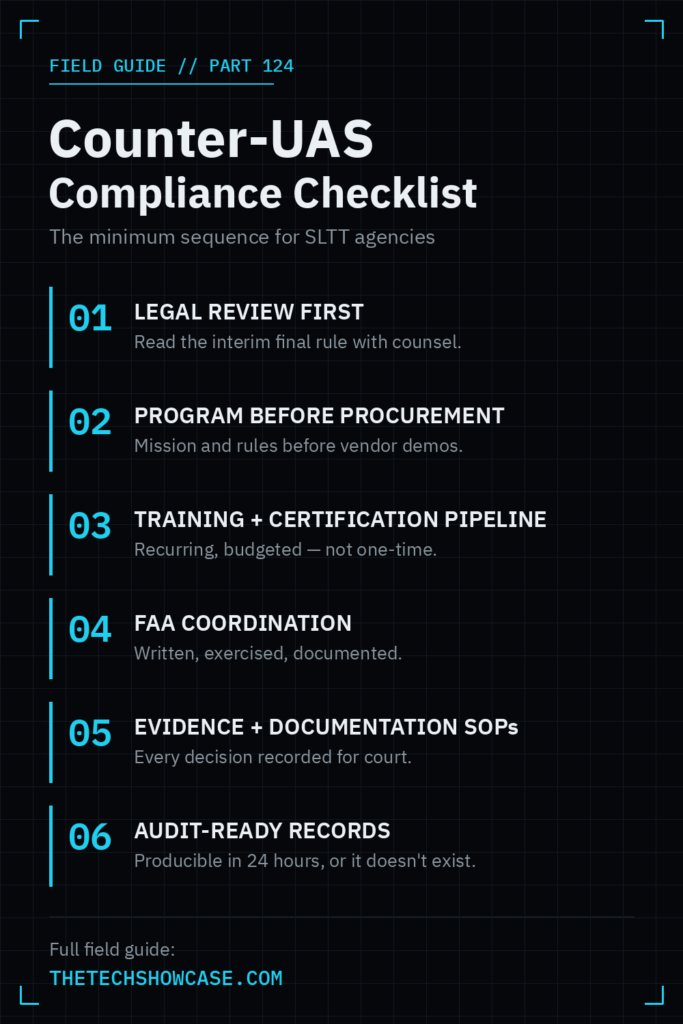
If you’re responsible for standing up counter-UAS capability at an SLTT agency, or advising one, here’s the minimum sequence:
- Legal review first. Read the interim final rule with counsel. Know exactly which authorities apply to your agency type and which don’t.
- Program before procurement. Define the mission, covered locations, decision authority, and rules for use of the technology before you evaluate vendors.
- Training and certification pipeline. Identify how your personnel get certified under the new framework, and build recurring training into the budget, not just initial qualification.
- FAA coordination and deconfliction procedures. Written, exercised, and documented.
- Evidence and documentation SOPs. Every detection, warning, and mitigation decision recorded like it will be reviewed in court, because eventually one will be.
- Audit-ready records. Training logs, maintenance records, incident documentation, authorization paperwork. If you can’t produce it in 24 hours, you don’t really have it.
If that list reads like an AI governance checklist, that’s not a coincidence. Regulated capability is regulated capability: named accountability, enforced controls, records nobody can quietly edit, and verification before trust. The domain changes; the discipline doesn’t. Be on the lookout for that post coming this week.
The 2026 World Cup came and went just two weeks into Part 124, which means the largest security event in the country arrived before almost any state or local agency could have been trained, certified, and authorized under the new framework. That’s the real lesson here. Major events keep coming: the Super Bowl, the 2028 Olympics. Standing up a compliant counter-UAS program takes longer than anyone budgets. The agencies that start building now are the ones that will be authorized when the next event lands in their jurisdiction. I’ve watched this pattern play out across military, law enforcement, and commercial operations for years, and it always ends the same way: after the first incident, you don’t get to pick which kind of agency you were.
Sources for readers who want the primary documents: the SAFER SKIES Act provisions in the FY2026 NDAA (Title LXXXVI), the DOJ/DHS interim final rule establishing Part 124 (Federal Register, effective July 1, 2026), and the FAA Part 108 NPRM docket including the reopened comment notices.
Chris Keon is an active sworn law enforcement officer and unmanned systems practitioner who has trained roughly 2,000 students across military, public safety, and commercial sectors. He writes field notes and builds practical tools at TheTechShowcase.com.
Want the AI tools I actually use to run this kind of work? Grab the free Consultant’s 25 AI Prompts: 25 practitioner-built prompts with guardrails. No fluff. Download it, use it today.